Showing posts with label Suarez. Show all posts

Saturday, February 11, 2017

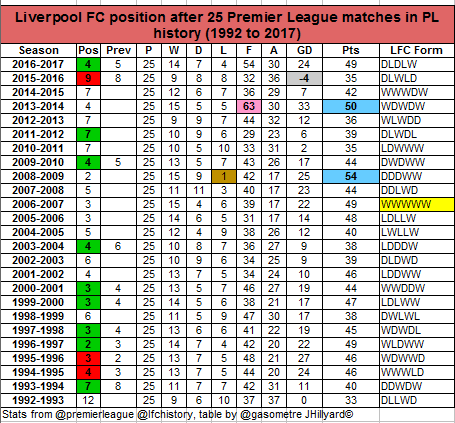
Liverpool F.C. after 25 matches in Premier League (1993 to 2017) [data via @premierleague & @LFChistory]


In 2006/07 Liverpool F.C. went on a 5 match winning streak starting with a 1-0 win vs Tottenham on 30/12/2006 and ending on Matchday 25 with 3-1 win vs West Ham

Liverpool F.C. had only lost 1 match in 2008/09 after 25 matches.

In 25 Premier League seasons Liverpool F.C. has only had a negative GD once (-4 in 2015/16) after 25 matches


Liverpool have only scored more goals after 25 Premier League matches once (63 in 13/14).

Liverpool F.C. have only twice had more points (54 in 2008/09 and 50 in 2013/14).


Sadio Mane with 11 goals is only behind, Fowler, Owen, Torres and Suarez after 25 Premier League matches

Tuesday, February 9, 2016

¿Benteke y Sturridge deberían jugar juntos?

Articulo traducido para Andrew Beasley (twitter) y su gran blog Bass Tuned To Red en ingles. Me puede seguir en twitter y pueden leer la version original aqui, muchas gracias!!  http://basstunedtored.com/2016/02/08/benteke-y-sturridge-deberian-jugar-juntos/ 

Un par de tuits de un compañero seguidor y estadista del Liverpool @natefc (Twitter y blog) lograron captar mi atención el domingo cuando los de Anfield cayeron 2-0 ante el Newcastle
Benteke y Firmino salen del campo después de haber tenido 1 pase combinado entre los dos en una hora de juego.
Goles cada 90 mins con Benteke como titular: 1.12 (403 mins), goles cada 90 mins con Benteke entrando desde el banquillo: 3.24 (111 mins), goles cada 90 mins sin Benteke: 1.91 (566 mins)
Estas estadísticas no se ven bien y tampoco muestran el impacto que tiene Benteke cuando arranca de titular (aunque con/sin estadísticas generalmente no dependen de solo un jugador) o de su juego asociado, si así se le puede llamar a un pase en una hora, con Roberto Firmino.
Decidí encontrar ese pase, esa maldita curiosidad mórbida es mas fuerte que yo…


A decir verdad, Ibe tuvo un disparo luego de esa secuencia, y entonces no fue de los peores pases del partido, para nada (lo cual es bastante fácil cuando Liverpool mal-coloca mas pases en un mismo partido en 5 anos), pero, es claro que los Rojos necesitan mas de sus dos delanteros si se decide jugar con alguno de ellos. Siendo justos, Firmino y Benteke combinaron siete veces en el partido anterior frente al Swansea, aunque ninguno de esos pases terminaron en disparos a puerta.
Entonces, basado en las estadísticas mencionadas anteriormente, debería estar limitado el rol de Benteke a ser un sustituto de alto impacto, o quizás deberían darle la oportunidad de jugar al lado de Daniel Sturridge en la delantera? Una de las estadísticas que estudio son cuantos minutos juega cada jugador del Liverpool. Mientras actualizaba la hoja de calculo luego del partido frente al Newcastle se hizo muy claro lo poco que juegan juntos Benteke y Sturridge. La intensidad del color muestra cuanto tiempo jugaron y el color gris significa que fueron sustitutos sin entrar al campo de juego.
DS and CB appsUno entro por el otro (o fueron sustituidos entrando/saliendo al mismo tiempo) en los últimos dos partidos de liga, vemos que Benteke y Sturridge solo han jugado juntos una vez, frente al Norwich en Anfield (no jugaron juntos aun bajo el mando de Klopp), e igualmente en ese partido solo jugaron 45 minutos ya que el belga salio lesionado en el entre-tiempo. Entonces, ¿como les fue como pareja delantera?
IMG_2268
Debemos tener cuidado ya que fue solamente una mitad de un partido, en casa, frente a un equipo recién ascendido, pero por lo que se ve, tuvieron una buena conexión: cinco pases en total, todos en el ultimo tercio de la cancha. Suarez y Sturridge promediaban 8 pases por partido, lo cual no significa que esta pareja sera tan determinante, por supuesto, pero tienen una frecuencia de conexión similar.
Creo que una pareja tradicional de dos delanteros favorecería a Daniel Sturridge y a Christian Benteke. En la liga esta temporada, la mayor combinación de chances creadas de Sturridge es con Danny Ings (con el primero creando uno y el segundo, dos), y solo jugaron juntos 184 minutos. En total los dos Daniel combinaron para doce pases, uno cada quince minutos.
Al igual que la pareja Benteke-Sturridge, debemos recordar que la mitad del tiempo de la pareja Sturridge-Ings fue contra el ultimo equipo en la tabla: Aston Villa, pero es evidencia que sugiere que dos delanteros podrían combinar bien para Liverpool. Puede que haya esperanza aun para un Benteke que arranque partidos de titular, si es que juega junto a un delantero neto.

No se olviden de que pueden leer todos los articulos traducidos en este blog o en el sector de español de Andrew Beasley aqui: http://basstunedtored.com/category/spanish-blog-posts/ 

Tuesday, October 28, 2014

Lost in Translation and Losing the Game

Racism in football is a matter of concern. It is a worldwide problem that occurs on and off the pitch. It is seen and heard in the vast majority of countries, in some on a smaller scale, in some on a much wider scale. And although there have been attempts to abolish it, with organizations such as “Let’s Kick Racism out of Football” and “Show Racism the Red Card” doing their upmost best, the issue just won’t dissipate.

Argentina is a nation that oozes football. The passion for the game is mind-blowing, one of the greatest derbies in the world is played here at least four times a year, if we include the not-so-important but nonetheless passionate Summer Cups, being River vs. Boca. It’s at the height of the Everton vs. Liverpool, Roma vs. Lazio, Barcelona vs. Real Madrid, Rangers vs. Celtic, Panathinaikos vs Olympiakos, PSG vs. Marseille, Ajax vs. Feyenoord derbies. All these derbies are filled with hatred and the Argentine derby is not one to be taken lightly. The build-up to the match weeks before, the colour, the flags, the drums, the singing and the outrageous racist chants are all part of this “Superclasico”.
River vs Boca

Racist chants are very common in Latin countries, unlike in the UK where everything is being done to abolish racism on and off the pitch. Here, in Argentina, however, little is being done. Only recently, while watching a River vs. Boca Summer Cup match, one could hear the River Plate supporters chanting “They are all from Bolivia and Paraguay”. It is extremely degrading, in Argentina, to call someone a Bolivian or Paraguayan, due to economic limitations, skin colour. The referee, when hearing these chants, decides to stop the match until the chanting ceases, when the chanting ceases the match restarts, when the match restarts so do the chants. Here’s when a typical trait of an Argentine is seen. The referee, instead of ending or stopping the match again says to the players and people in charge: “There’s nothing I can do about it, let’s carry on.” So the match goes on, the flags wave, the drums beat and the outrageous racist chants continue, all for the love of the game. It is part of the culture and something that will take time, if ever, to change.

The English Football League now has more foreigners than ever before, players come and go from different countries across the globe and not only have to adapt to a different style of play but also have to adapt to a different style of life, with the cultural and traditional ideologies that come with it. This takes time, sometimes quite a while. The fans have also had to adapt and that is also taking time - who can forget the banana peels thrown at John Barnes in 1987 - we seemed to have moved so far on since then, but it is still something very difficult to abolish.  Recently, in the UK, there have been two on-field racist incidents: the Suarez-Evra and the Terry-Ferdinand affairs both in October 2011. And though these were both similar they were both very different too. In the Terry-Ferdinand affair both players were English, they both know what was said and what wasn’t and in what context the words were used, therefore being a much easier case to study. On the other hand we have a Uruguayan and a Frenchman. By fact the word “negro” (black) used by Suarez to Evra, in Latin countries means “mate”, not always in a friendly way, but nothing more than that. Extracts from Suarez’s new book “Crossing the Line – My Story” show how the Uruguayan felt and still feels about this dilemma and ongoing situation. He said: “Did I use the Spanish word "negro" in an argument that took place, in Spanish, with Patrice Evra on 15 October 2011 in a game between Liverpool and Manchester United? Yes. Is the word "negro" the same in Spanish as it is in English? No, absolutely not. Am I a racist? No, absolutely not.”
Suarez and Evra
Suarez comes from a background of controversial incidents which made it all the more easy to punish him. Suarez has had dark-skinned teammates, dark-skinned family and friends. It is very hard to believe he would use the word in a derogatory sense. He went on to say: “As I am now fully aware (and I did not even know this at the time), in English there is a word that is spelled the same way but is pronounced differently and it is highly offensive: negro, pronounced nee-gro. Negro (pronounced neh-gro) in Spanish means "black", nothing more.”
Moreover, when the punishment came to an end and Liverpool played against Manchester United with Suarez on one side and Evra on the other there was the hand-shake incident. Now, I wonder, if I were the victim of racial abuse I would never want to shake hands with the perpetrator of such offense and, if, let’s say, I was falsely accused of racially abusing someone I definitely wouldn’t shake hands with the person accusing me of it.

The footballing world is all for the abolishment of racism, a utopic matter in the times we live in. Cultural differences and ideologies must be taken into account for each and every incident thus understanding why and in what context the words are being said.

I have often been called “negrito” by people in the streets in Argentina and I’m white, should I take this as an offense? Should I consider it an ironic joke? Or should I take it as it is? Part of the culture.

For more information regarding anti-racism organizations in football, visit:
www.kickitout.org

Tuesday, September 2, 2014

Complete Guide to LFC's Summer Signings - Rebuilding a team around a team & the Future of LFC

Life without Suarez has begun for Liverpool F.C. and Liverpool fans around the world. The prospect of not seeing the Uruguayan with a Liver-bird on his chest causing havoc was and maybe still is a devastating idea for most. There may be a lack of nutmegs, a lack of high calibre goals, a lack of mazy runs, a lack of protesting, a lack of diving, a lack of that goal-scoring prowess, but F.S.G., Brendan Rodgers and Liverpool F.C. have invested well. With the sale of Suarez and a few other departures, plus some money from owner John W. Henry, all areas of the team have improved and instead of being a team playing around a player it seems as if Liverpool will be a team rebuilt around a team. Rodgers will be able to instil more of his ideology and tactical approach with a team full of players that he wants and needs. It will take some time, changing of tactics and gelling of new players thus fans will have to be patient. The rise of Raheem Sterling (still only 19 years old), a steadier defence with the arrival of a right back, a center back and a left back, a midfield with the experience in Gerrard and youthful additions helping Henderson, new wingers and Sturridge alongside Balotelli upfront, who can both score at least 20 goals a season and will be taking the role of goal-scoring machines with Suarez gone, make Liverpool a team with a solid backbone and strong second line of players that can fit in easily. The defensive frailties from last season need to dissipate, and fast.


The Anfield team are back in Europe to every fan’s delight, the Premier league was a few points adrift in 2013/14 and there is silverware in the form of the Capital One Cup and the F.A. Cup. Four fronts, four pieces of silverware possible, squad depth needed, and this is exactly what F.S.G., Ian Ayre and Rodgers have started putting together. Whether Suarez’s departure was a good or bad move only time will tell. Stats have shown us that Liverpool won more points without Suarez than with him last season (percentage-wise), let’s hope that those stats stay the same.

Here are Liverpool F.C.’s new summer signings:

Lambert, Lallana, Can, Lovren, Markovic, Origi, Balotelli, Moreno, Manquillo

There we have it, nearly a complete starting XI of new signings (with the possibility of a 10th player, goalkeeper Victor Valdes, arriving soon on a free transfer), adding quality, depth and future to Liverpool's current squad. For a full profile of all Liverpool's new signings see below. Players have gone on loan: Teixeira, Wisdom, Ibe, Alberto, Aspas, Ilori, Coates, Assaidi, Smith, Páez. Players have left on permanent deals: Suarez, Reina, Coady, Kelly, Peterson, Robinson, Agger, Adorjan and L.F.C. has received a total of £83 million. Players have come in: Stewart (youth team), Lambert, Can, Lallana, Markovic, Lovren, Origi, Manquillo, Moreno, Balotelli and L.F.C. has spent a total of £117 million. For owners who have a strict spending policy and are also defining the future of one of the most important football teams in the world, only letting 34 million out of your pocket must feel great. They are defining their own way of managing a football team, similar to the infamous "Moneyball" idea. Buying players with specific traits, who are young, who are not too expensive, who can fit into a specific role and who may then be sold for much more, if necessary, in the future. This may be a risky way of doing business especially when you have the power to affect so many people and fans in the world, however they have done well up to now and their promises (unlike the Americans Hicks and Gillett, who came before J.W.Henry) have been kept. The redevelopment of Anfield is another key aspect for the successful future of Liverpool. Week in and week out the stadium is jam-packed. 45000 passionate fans flock to Anfield every week to watch the team win, lose or draw, no matter what. Redeveloping Anfield into a stadium for 58800 people would bring in a lot more revenue and would allow the stadium facilities to be top-notch, attracting more and more followers from around the globe. Anfield currently lies 7th in capacity of football stadiums in England, by 2017 it will have moved up to 4th, behind Wembley Stadium (90000), Manchester United's Old Trafford (75700) and Arsenal's Emirates Stadium (60300).
Here's what the proposed stadium should look like in 2017:


The transfer window has now officially closed and 3 matches have already been played, Southampton at home, Manchester City away and Tottenham away. Liverpool had a difficult 1st match of the season but took the 3 points, City away proved to be as difficult a venue as always and came away with nothing. Tottenham in London was a game Liverpool needed to win desperately and like last season took them apart. So sitting 5th after 3 matches with 6 points from a possible 9 is not a bad start at all. Hopefully the arrival of Balotelli and the synchronizing of the new signings will make the difference Liverpool are looking for.


Having squad depth is essential for a team that has to play on 4 fronts: the Premier League, Champions League, F.A. Cup and Capital One Cup. Hopefully Rodgers will deploy some young talents coming through the ranks for them to get experience playing top level football. Here are 4 teams possibilities for each of these fronts:


Profiles of L.F.C.'s new signings:

Signing N1: Rickie Lambert was born 16 February 1982. He is a 1.88mts (6 ft 2 in) striker and will be playing with the number 9 shirt. He has recently been called up to the England national team. Lambert started playing professionally at Blackpool, after Liverpool let him go as a youngster. He went on to play for Macclesfield Town, Stockport County, Rochdale, Bristol Rovers and Southampton, before making a dream return Liverpool. Lambert was a key signing for Southampton, becoming their top scorer as they were promoted twice in 2 seasons, first from the Championship to League One in 2011 and to the Premier League the following season. He has won three league Golden Boots. Lambert is known for his large stature and physical performances, a typical area striker who can be on a pitch for 2 seconds and will already have a shot at goal to his name. He has drawn comparisons with Southampton legend Matthew Le Tissier for his ability in front of goal and penalty record.In August 2013, Lambert was called up to the England team for the first time and scored on his debut at Wembley in a friendly against Scotland with his first touch. He was part of the England squad for the 2014 F.I.F.A. World Cup. Penalty record: scored 6 from 6 attempts at Stockport County, and 5 from 6 attempts for Rochdale. 13 goals from 14 attempts at Rovers. At Southampton, he scored all 34 attempts. He has a career total of 233 goals in 619 matches at club level and 3 goals in 7 matches on the international stage.


Signing N2: Emre Can, Bayer Leverkusen confirmed he would be joining Liverpool after activating his release clause £9.75 million. Can was born in Frankfurt and began his footballing career with SV Blau-Gelb Frankfurt, after six years he joined Eintracht Frankfurt before moving to the youth ranks of Bavarian giants Bayern Munich. He later switched to Bayer Leverkusen. Brendan Rodgers said in a press conference later in the week that Can was an "inspirational young talent". He has been to compared to fellow German midfielders Michael Ballack and Bastian Schweinsteiger, because of his mid-fielding ability to attack and defend, constantly going back and forth. Can is a player that makes the necessary sacrifices a team needs, a complete box-to-box midfielder. He's a smart player, who has played a number of positions despite his tender age. The German is a strong and tall footballer and fits Rodgers' young-versatile-player block perfectly. Emre loves running with the ball at his feet and finding space after dribbling. His sacrificing for the team sometimes brings him discipline problems, receiving 14 yellow cards in 39 matches with Bayer Leverkusen. Offensively he may not be the best goal-scorer out there but certainly tries to create chances with sublime passing and through balls.


Signing N3: Adam Lallana was born 10 May 1988. He is English and is Liverpool's new 1.73mts (5ft 8 in) attacking midfielder wearing the number 20 shirt. He began his youth career with Bournemouth before transferring to Southampton in 2000, where he became a professional in 2006. He broke into Southampton's first team as they earned two promotions from League One to the Premier League, becoming captain in 2012. Lallana was given his senior international debut for England in 2013 and was selected for the 2014 FIFA World Cup. He is a creative player who loves giving and receiving the ball especially in the opposition's half. He is not a player who will help much in defence but Lallana is a fast dribbler and loves an attacking style of play. He is not a typical individualistic kind of footballer, opposed to Sturridge who sometimes goes alone when other options may be better. Adam is a good long-range shooter and gets into the box as often as possible, a very nerveless player who has dance-like moves. A positive aspect is that he knows Lambert well and their partnership will strive given the chance.


Signing N4: Lazar Markovic was born 2 March 1994 and is Serbian He plays for the Serbian national. He was described by Andrea Stramaccioni as a player with exceptional qualities and impressive acceleration. With this signing Rodgers is definitely setting his ideas and style. Markovic is a fast growing talent who, 2 years ago, was one of the pillars for Partizan who dominated the Serbian league. He has now landed at Anfield after a brief spell at Benfica. He is quick with the ball at his feet, loves dribbling and needs a Liverpool-style of play to adapt well. Lazar can play as a winger on either side or as a striker, although his preferred area on the pitch is down the right wing. The Serbian needs 3 important aspects to show-off his quality: not too much defensive responsibility, freedom to roam upfront and space in front of him. He has an amazing change of rhythm and is unstoppable when he gains pace. Markovic is an exciting player who tires easily only completing the full 90 minutes in 16 of the 49 matches he played for Benfica. He prefers scoring nearer to the goal than trying long shots which is not one of his strengths.


Signing N5: Dejan Lovren, born 5 July 1989 is a Croatian footballer,  1.88 m (6 ft 2 in), who plays as a central defender and will be wearing the number 6 shirt. Lovren began his career at GNK Dinamo Zagreb before moving to Olympique Lyon in 2010. He spent three-and-a-half seasons with the Ligue 1 team, winning the 2012 Coupe de France. In 2013, he signed for Southampton, and after only one season there, he has joined Liverpool for £20 million. Although born in what is now Bosnia and Herzegovina, Lovren has represented Croatia at many levels and has been a full international since 2009. He has gone on to make more than 25 appearances and score two goals for his country, as well as being selected for the 2014 FIFA World Cup in Brazil. Dejan Lovren, is a great defender, who has played total of 247 matches representing club and country and bagging 10 goals. His passing skills and ball interceptions are a high point, however discipline is not. Throughout his footballing career Lovren has many honours to his name. With Dinamo Zagreb he won the Croatian Championship in 2005-2006, 2008-2009 and the Croatian Cup in 2009. When loaned to Inter Zapresic he won HNL championship, 2006-2007. Playing for Olympique Lyon, the club won the “Coupe de France” in 2012. Lovren is a defensive leader and has already settled into Liverpool's defence despite playing only 3 games. He is strong in the air in both areas and very vocal.


Signing N6: Divock Origi was born 18 April 1995 in Ostend. He is Belgian and was bought by Liverpool but has since returned to Lille on loan where he will play for one more season. Divock was part of the Belgian National team in Brazil at the 2014 World Cup where he played around 245 minutes scoring 1 goal and getting 1 assist. He ended up being chosen ahead of Lukaku in Marc Wilmots team. Origi can play as a winger on either side or an out-and-out striker. He is 1,84mts tall but his height doesn't affect his good ball control. He always looks towards the opposition goal and plays very vertically. Divock is an extremely fast and agile player, resembling Sterling who is also 19. He is one for the future and fits FSG's policy well: a player who is relatively cheap and will improve and therefore may be sold at a higher price.


Signing N7: Javier Manquillo, is a 20 year-old, right back born in Spain. He began in Real Madrid's youth system with his brother and then moved on to city rivals Atletico de Madrid's youth team. In 2012 he was promoted to Atletico's senior team playing 42 matches for their B team and six for their A team. He also featured for Spain at every youth stage possible: Under 16's, U-17's, U-18-s, U-19's and U-20's. Manquillo won La Liga in 2013/14, the Copa Del Rey in 2012/13, Under 19’s Eurocup 2012, European SuperCup 2012. Nicknamed "the red and white gazelle", he is known for his speed and long stride, being able to outrun any opponent down the sideline. Manquillo is considered to be the future right back of the Spanish National team. He has been compared to Toulouse’s Serge Aurier due to his market value and similar footballing traits. Manquillo is a mix between Flanagan and Johnson. Similar to Jon in the way he always gives you his all, always trying to be correct and offensively similar to Glen with speed and being able to go back and forth down the right. The perfect balance of the two, which is an ideal fit for the right-back Liverpool needs. He comes to Liverpool F.C. on a 2-year loan.


Signing N8: Alberto Moreno was born 5 July 1992. A Spanish footballer from Seville, Andalucia, Moreno came through the youth ranks at hometown club Sevilla F.C., spending his first season as a senior with the reserves in the third division. In 2012 he made his first-team debut in La Liga, coming off the bench for Manu del Moral's team in the last minutes of a 0–1 away loss against Athletic Bilbao. In February 2013, Moreno was definitively promoted to the main squad. Moreno is more than just a teeth-bearing full-back, he can also get forward often and well. He is quick, good with the ball and 33 successful take-ons in the Spanish league last season shows he’s not afraid to beat a man either. Even though he didn't get any assists, he did score three goals. Over 40 percent of his key passes came from wide on the left in the final third of the pitch. The 22-year-old is the latest player to come through the youth system at Sevilla and be sold for big money. Jose Antonio Reyes, Sergio Ramos and Jesus Navas are some to have gone before him; now Moreno will swap Andalucia for Liverpool, where he is expected to become Brendan Rodgers’s first choice left-back. Moreno has taken the No.18 shirt at Liverpool, but wasn't registered fast enough to be available for selection in this Sunday's Premier League season opener against Southampton.


Signing N9: Mario Balotelli, born 12th August 1990 in Palermo, Italy. He is a strong, 1.89mts (6 ft 2 in)tall striker. His birth name was Mario Barwuah and parents were from Ghana. He was given into foster care at the tender age of 3 and was adopted by the Balotelli family. His footballing career began at Lumezzane in the Italian 3rd division and after a failed trial at Barcelona he moved to Inter Milan on loan in 2006. “Super” Mario scored 20 goals in 59 appearances for Inter and in 2010 was bought by Manchester City for a fee around £23.5 million and was reunited with his former boss Roberto Mancini. At City he scored 20 in 54 appearances before moving back to Italy in 2013 for £16 million. Playing for Inter Milan’s archenemies, A.C. Milan, he has gone on to score 26 goals in 46 appearances for the club. On the international stage he has played for Italy since 2010 and has scored 10 goals in 33 matches. Liverpool has agreed a 4-year deal with Balotelli's agent for a transfer fee of £16 million. He will wear his typical number 45 shirt at Anfield. Balotelli is a difficult player to define. No one can deny his footballing traits, power, flair, agility and technical ability. He’s a set-piece master, free-kicks and penalties coming easy. He has won personal awards, including: Golden Boy (2010), FA Cup Final MOTM (2011), UEFA Euro Team of the Tournament (2012), Serie A Team of the Year (12/13). The big question here is whether Rodgers and the Liverpool team will be able to tame this fierce being. His attitude on and off the field will have to change. A poor image and sometimes aggressive and immature, he’s a sulky player who doesn't celebrate goals. Asked why, he responded: “This is my job, have you ever seen a postman deliver a letter and run off in celebration?” Many footballing idols across the planet have talked of Balotelli's potential and have said that if surrounded by the right people and the correct environment, Mario can become one of the world’s best. He already considers himself as that, saying in 2010: "There's only one that is a little stronger than me: Messi. All the others are behind me." His agent, Mino Raiola, has said that this is Mario’s last chance to show himself at a big club. Hopefully Liverpool will get the best out of Balotelli, hopefully he will become the world-class player he wants to be, hopefully he will form a mouth-watering partnership with Sturridge and Sterling and hopefully he will guide Liverpool to the top.


The Liverpool F.C. team and squad has grown well, new players have adapted and are adapting to a style imposed by a young, fresh manager, who feels the Anfield way of life. Rodgers has the ability to make this squad tick, to make this squad show passion, to bring home the silverware.The lineups have altered and styles of play have changed but the spirit and idea is there, foundations are set, I hope we are in for a great run like last season and why not better!

Images courtsey of @dianqamajaya
Lineups created at lineupbuilder.com
Videos courtesy of youtube.com
Friday, August 29, 2014

FSG – A critical evaluation.


To compete with top teams nowadays, a team needs financial backing; they need top dollars coming from someone or somewhere other than the club itself regardless of history. Liverpool FC is a club renowned for its history, culture and tradition. We rely on it so much that we still believe that it is enough to get us to high places, however in the past 10 years Liverpool have only won 5 trophies. One of them being the amazing Champions League in 2005 but still missing that elusive Premiership title that every fan craves. On the 6th February 2007 two American, Hicks and Gillett bought Liverpool FC. For three years the fans heard promises come and go, stadiums, players, managers come and go. Fortunately that reign came to an end, with court battles included and on the 15th October 2010 NESV (New England Sports Venture) now known as FSG (Fenway Sports Group) and their owner John W. Henry bought Liverpool Football Club.

Football as we know it has changed. It is no longer a city, town or suburb attraction. It has become a worldwide, global fascination. The main cause of this phenomenon is media and globalization. We have witnessed a fine display of the globalization of Liverpool during the pre-season tour of Australia and Asia where fans flocked by the thousands to catch a glimpse of their favourite team and players. This commercial asset is one LFC and their owners must and will take advantage of.

After the tumultuous time with Hicks and Gillett most of us thought we were going down the same road with Henry and FSG and they didn’t fully start off on the right foot. Even though words can be soothing and hearing quotes from the Chairman of FSG saying: “We recognize that Liverpool Football Club is a historic institution ultimately grounded in the community and the fans. Our first step as new owners will be to listen”, is all very nice but Liverpool fans needed to see actions and for the owners to put money where their mouth is.

One of FSG’s first moves was to get rid of Hodgson only after 6 months in charge and appoint Kenny Dalglish. A very bold move that went down extremely well with Liverpool fans who now had “The King” back where he belonged. Following this came a string of sales, new signings, record fees and positivism. The likes of Suarez, Carroll, Downing, Adam, Enrique, Coates, Bellamy, Henderson, Doni all come into the re-shaping of the LFC team, with the “help” of Liverpool’s new Director of Football, Damien Comolli. However things quickly began to change. Their “moneyball’ stance of finance and how to buy and sell players is a very American way of doing things, whether this works only time will tell, many are very skeptical. Of the new players that came in 2011, today, we see that Luis Suarez is the only one who has lived up to the price tag. Jordan Henderson has had his ups and downs and seems to be a much more mature player nowadays, the rest have faded off to below-mid table teams, leading to the understandable sacking of Comolli. This affected Dalglish’s team and never got going. Although winning the Carling Cup in 2012 after 6 years of no trophies the results in the Premiership were not as expected and FSG parted ways with Dalglish. Tom Werner, chairman of FSG, said: “Kenny came into the Club as Manager at our request at a time when Liverpool Football Club really needed him. He didn't ask to be Manager; he was asked to assume the role. He did so because he knew the Club needed him. He did more than anyone else to stabilize Liverpool over the past year-and-a-half and to get us once again looking forward.”

Rodgers is appointed as manager, a young manager without experience managing a top team but with a view of football that could give anyone goose bumps when played with perfection. FSG have taken a gamble with Rodgers, but I consider it to be an important step forward and hopefully we will allow him to develop and show us what he can do. Rodgers transfer policy seems to adapt quite well to the style of FSG and although we lost an irreplaceable leader in Jamie Carragher we seem to have a good player in Kolo Toure, a player with the necessary experience to talk and boss people about. Young players are coming in for reasonable prices, fringe players are being let go and exciting times lie ahead. FSG has promised the redevelopment of Anfield, an amazing item on the to-do list and plans have begun with the purchase of housing around the grounds.

Liverpool fans are still very incredulous to what the future holds and only time will tell but rest assure, FSG are in for the long run, and rest assure, Liverpool FC will once again become great.

Wednesday, June 25, 2014

Lost in Translation and Losing the Game.


As an avid football fan I could watch the game 24/7, unfortunately there is sleeping, eating, working and the occasional going to the bathroom. Luckily I live in Buenos Aires, Argentina a nation that oozes football. Not only do I have the possibility of watching the Argentine league, but I also have the chance to see matches from all over the globe including England, Italy, France, Spain, The Netherlands and others. The passion for the game here is mind-blowing, one of the greatest derbies in the world is played at least four times a year, if we include the not important but nonetheless passionate Summer Cups, being River vs. Boca. It’s at the height of the Everton vs. Liverpool, Roma vs. Lazio, Barcelona vs. Real Madrid, Rangers vs. Celtic, Panathinaikos vs Olympiakos, PSG vs. Marseille, Ajax vs. Feyenoord derbies. The build-up to the match weeks before, the colour, the flags, the drums, the singing and the outrageous racist chants are all part of this “Superclasico”.


Suarez and Evra go head to head.
Racist chants are very common in Latin countries, unlike in the UK where everything is being done to abolish racism on and off the pitch. Here, however, little is being done. Only recently, while watching a River vs. Boca Summer Cup match, one could hear the River Plate supporters chanting “They are all from Bolivia and Paraguay”. It is extremely degrading, in Argentina, to call someone a Bolivian or Paraguayan, due to economic limitations, skin colour. The referee, when hearing these chants, decides to stop the match until the chanting ceases, when the chanting ceases the match restarts, when the match restarts so do the chants. Here’s when a typical trait of an Argentine is seen. The referee, instead of ending or stopping the match again says to the players and people in charge: “There’s nothing I can do about it, let’s carry on.” So the match goes on, the flags wave, the drums beat and the outrageous racist chants continue, all for the love of the game. It is part of the culture and something that will take time, if ever, to change.
Handshake incident.
The English Football League now has more foreigners than ever before, players come and go from different countries across the globe and not only have to adapt to a different style of play but also have to adapt to a different style of life, with the cultural and traditional ideologies that come with it. This takes time, sometimes quite a while. The fans have also had to adapt and that is also taking time - who can forget the banana peels thrown at John Barnes in 1987 - we seemed to have moved so far on since then, but it is still something very difficult to abolish.  Recently, in the UK, there have been two on-field racist incidents: the Suarez-Evra and the Terry-Ferdinand affairs both in October 2011. And though these were both similar they were both very different too. In the Terry-Ferdinand affair both players were English, they both know what was said and what wasn’t and in what context the words were used, therefore being a much easier case to study. On the other hand we have a Uruguayan and a Frenchman. I know, by fact, that the word “negrito” used by Suarez to Evra, in Latin countries means “mate”, not always in a friendly way, but nothing more than that. Suarez comes from a background of controversial incidents which made it all the more easy to punish him. Suarez has had dark-skinned teammates, dark-skinned family and friends. It is very hard to believe he would use the word in a derogatory sense. Moreover, when "El Pistolero's" ban came to an end and Liverpool played against Manchester United with Suarez on one side and Evra on the other there was the hand-shake incident. Now, I wonder, if I were the victim of racial abuse I would never want to shake hands with the perpetrator of such offense and, if, let’s say, I was falsely accused of racially abusing someone I definitely wouldn’t shake hands with the person accusing me of it. Finally, on this matter, I have often been called “negrito” by people in the streets in Argentina and I’m extremely white, should I take this as an offense? Should I consider it an ironic joke? Or should I take it as it is, part of the culture.